










By Dr. Lucy Hinnie |
Alongside its new Education Lead Sally Latham, Wikimedia UK has also appointed its first Topics for Impact Coordinator. This blog discusses what Topics for Impact means for the Wikimedia movement in both a global and UK context.
Introduction
‘If we fail to move beyond speeches into real action, our societies will lose faith’ – Luiz Inácio Lula da Silva.
In November, over 56,000 individual delegates made their way to Belém, Brazil, to participate in the COP30 climate summit. Each day the issue of climate change becomes more and more pertinent to lives across the globe. The impact of our ‘real action’, or indeed lack of action, when it comes to questions of climate, will be felt for generations to come.
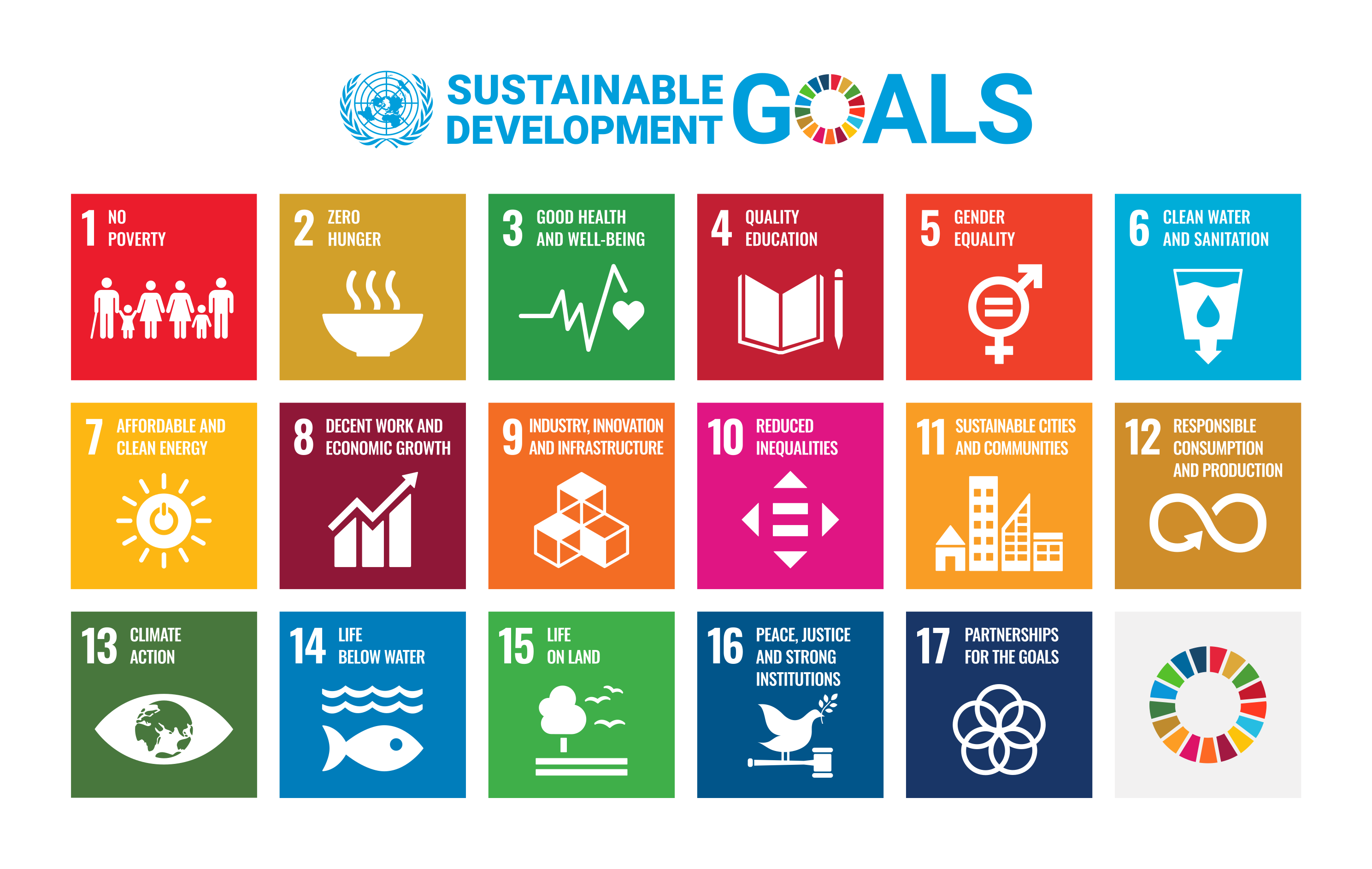
This urgency is crystallised in the UN’s 17 Sustainable Development Goals which cover a number of crucial elements of human life: from energy to the economy, oceans to land, health to hunger. In these aims, the UN lays out ‘a shared blueprint for peace and prosperity for people and the planet, now and into the future’. A commitment to these sustainable goals is integral to the Wikimedia UK 2025–30 Strategy. Under our Strategic Aim 3, we will: Increase free, verified and open access to knowledge and information about the climate crisis and other important topics, by delivering impactful projects with relevant partners, and advocating for the release of content.
With the proliferation of Large Language Models often referred to as “AI” and mis- and disinformation, keeping information on Wikipedia accessible, free and moreover, verifiable, has never been more important. In shifting focus and time to topics for impact, we will effect change that has positive and powerful repercussions for society.
What are topics for impact?
The question of what ‘topics for impact’ are, and how they relate to both our work and global society, is an important one. Looking at the Wikimedia movement’s work to ‘identify topics for impact’, we can see a real and tangible focus on ‘the different ways in which Wikimedia content can make an impact on improving people’s lives’. In looking at the social issues underpinning the UN SDGs, a picture starts to emerge of Topics for Impact as those which directly concern human wellbeing: in this context, health, human rights and climate.
Wikimedia UK and Topics for impact
Precisely defining what these topics for impact are is a curious process: on the one hand, the answers are crystallised in the UN SDGs. On the other, there is an element of reactiveness to defining a topic for impact, as the world is ever-changing, with new, pressing issues and questions emerging in unpredictable ways and at pace. At Wikimedia UK we are committed to making informed decisions about where to put our resources and expertise in open knowledge practices.
Wikimedia UK has a strong history of work which intersects with what we now term topics for impact. Since 2022, we have supported our first climate-focussed residency at the Global Systems Institute, with Wikimedian-in-Residence Tatjana Baleta. The articles edited as part of this project have gained over 190 million views.
From 2021 to 2025, Adam Harangozó was Wikimedian-in-Residence at the National Institute for Health Research, improving access to health information on Wiki. Ongoing work at partner organisations like the IDEA Network (Inclusion, Diversity, Equity & Accessibility in Open Knowledge Network) at the University of St Andrews reflects our commitment to engaging with partners doing crucial work in areas like medical knowledge equity.
In establishing a permanent role on the Programmes team for Topics for Impact, Wikimedia UK is further emphasising our commitment to these vital areas of research and development, enriching existing partnerships and seeking new areas of work.
Where are we looking first?
Applying large global issues to a local context can be daunting: how climate change presents itself, for example, varies hugely from country to country. For the four nations of the UK, we will be looking closely at community needs, as well as strengthening our relationship with the Wikimedia Foundation’s Wiki For Human Rights campaign. Even closer to home, our latest Mini Wiki challenge focuses on images of climate impact and the elements on day-to-day life in the UK.
Our commitment to ongoing annual drives like Wiki Loves Earth and 1lib1ref will be reinforced with topics for impact in mind, and newer initiatives such as 2025’s Mini Wiki will be utilised as tools for change in the key areas of impact: health, human rights, and climate change. Through promoting editing, upskilling volunteers and interested members of the public, and close attention to metrics of change, we will develop and deliver an impactful programme of work.
This programme will be sustained by the creation of new partnerships with like-minded organisations working in these areas. There is a reciprocity to how we work in our medium and long-term projects: in helping to transform content in a topic area, we uplift the voices of partner organisations, and in turn, they may find the way they work shifting in new and helpful directions, thanks to an increased understanding of the value of open knowledge.
A little about me

I’ve worked in the Wikimedia movement for nearly five years now, beginning my career as Wikimedian in Residence at the British Library (2021–23) and going on to work with the Connected Heritage project (2021–23), the Royal Albert Memorial Museum (2022–24) and the GLAM-E Lab (2023–24).
I currently work part-time at the University of Leeds as their Wikimedia and Open Knowledge Adviser alongside my work as Topics for Impact Coordinator at Wikimedia UK.
Get involved
If you have any questions, thoughts or ideas around topics for impact, please don’t hesitate to get in touch with programmes@wikimedia.org.uk. We are always interested to hear from potential partners, contributors and interested parties.